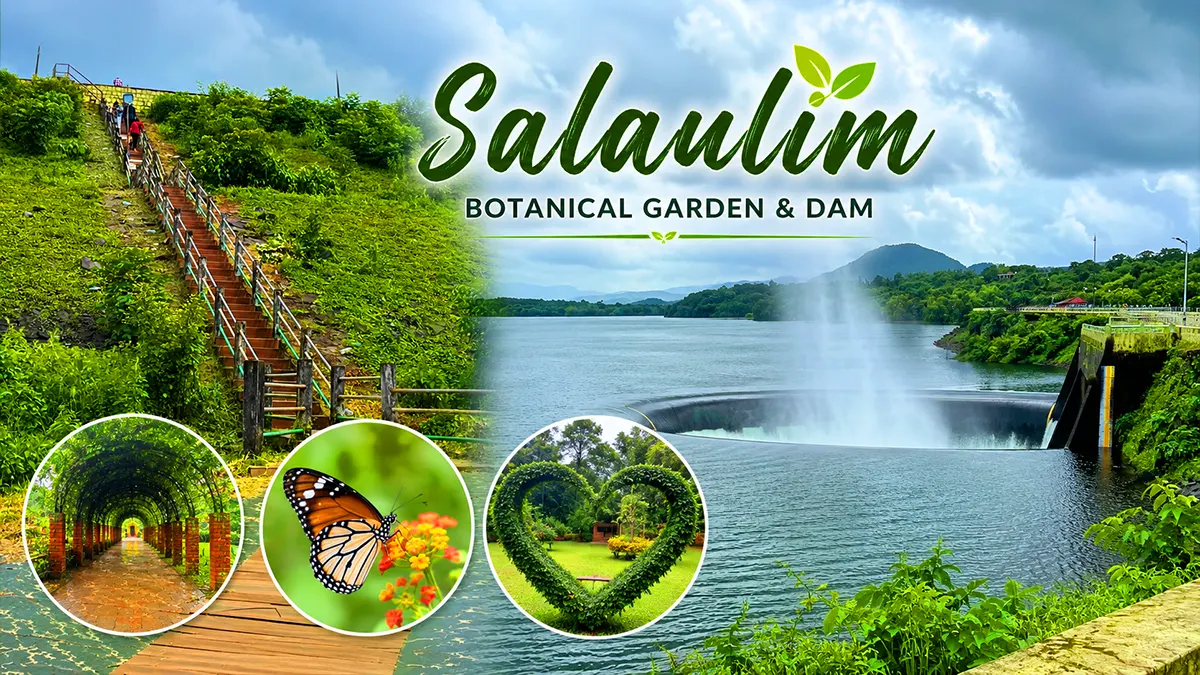
Salaulim Botanical Garden Cum Eco Recreational Park and Salaulim Dam are among the fascinating places to explore in the green hinterland of South Goa. Far away from the busy beaches and crowded tourist areas, Salaulim offers a completely different experience — lush greenery, gardens, butterflies, medicinal plants, peaceful walking areas and the spectacular landscape of the Salaulim Dam.
If you are searching for places to visit in South Goa, hidden places in Goa, botanical gardens in Goa, Salaulim Dam, Salaulim Botanical Garden, Goa monsoon places or offbeat places to visit in Goa, this destination deserves a place on your list.
The area becomes particularly attractive during the monsoon when the surrounding landscape turns intensely green and the Salaulim Dam can offer spectacular views of flowing water.
I recently visited the Salaulim Botanical Garden Cum Eco Recreational Park and Salaulim Dam and captured the experience in a full-length video.
Table of Contents
Watch the complete Salaulim Botanical Garden and Dam video
In this guide, I will take you through what you can see at the Botanical Garden, the Butterfly Garden, the Medicinal Herbal Garden, the Salaulim Dam, visitor information, entry fees, timings, photography restrictions and the fascinating story of Curdi (Kurdi) — the village that lies beneath the reservoir.
Where is Salaulim Botanical Garden and Salaulim Dam?
Salaulim is located in Sanguem Taluka in South Goa, in the interior part of the state.
Unlike the coastal tourist belt, Sanguem is known for its greenery, forests, rivers, waterfalls and other nature-oriented attractions. Goa Tourism describes Sanguem as one of the state’s larger interior talukas, away from the coast and surrounded by dense vegetation and lesser-known attractions.
The Salaulim Dam is built on the Salaulim River, a tributary of the Zuari River, and forms an important part of the Salaulim Dam Irrigation Project. The project provides benefits for irrigation and drinking-water supply.
Around the dam is the Salaulim Botanical Garden Cum Eco Recreational Park, which adds a completely different dimension to the visit.
Instead of simply coming to see a dam, visitors can explore a large green recreational and educational environment featuring different gardens and nature-related attractions.
Salaulim Botanical Garden Cum Eco Recreational Park
The first thing you notice when entering the Botanical Garden is the greenery.
The garden has a peaceful atmosphere with trees, plants, landscaped areas, pathways and different recreational features.
During the monsoon, the garden becomes especially attractive. The vegetation looks fresh, the trees are covered in new growth and the entire area takes on different shades of green.
It is a refreshing contrast to the more commercial and crowded parts of Goa.
The garden has also been developed with an emphasis on nature education and eco-tourism. Government documents have identified the Salaulim project as an eco-tourism and nature-education initiative, with further development planned around the dam and botanical garden.
For visitors, this means that Salaulim is not just about taking a photograph of the dam.
There is plenty to explore within the garden itself.
Butterfly Garden at Salaulim
One of the most interesting sections of the Botanical Garden is the Butterfly Garden.
Butterflies are an important part of the natural ecosystem and depend heavily on suitable plants for food, shelter and reproduction.
The Butterfly Garden has been designed to create an environment that attracts and supports butterflies while also educating visitors about them.
Butterfly-friendly features
Host plants for butterflies
The garden contains carefully selected plants that act as host plants for butterflies.
These plants can provide food and suitable conditions for different stages of the butterfly life cycle.
Water pond for butterflies
A shallow water pond has been created to provide butterflies with water and minerals.
This is an interesting feature because butterfly gardens are not simply about planting colourful flowers. Water, minerals, shelter and host plants can all play a role in creating a suitable habitat.
Informative signage
Visitors can also find information boards explaining butterflies, their life cycles, habitats and conservation.
This makes the garden especially interesting for children and anyone who wants to learn more about biodiversity.
Why is the Butterfly Garden Important?
The Butterfly Garden has several objectives.
Butterfly conservation
Creating suitable habitat can help support butterfly populations and encourage biodiversity.
Environmental education
Visitors can learn about the importance of butterflies and their relationship with plants and ecosystems.
Community awareness
The garden can also serve as a place for awareness programmes and educational activities related to butterfly conservation and sustainability.
Walking through the Butterfly Garden is therefore not simply a sightseeing experience.
It gives visitors an opportunity to see how plants and insects are connected within a natural environment.
Medicinal Herbal Garden at Salaulim
Another major attraction within the Botanical Garden is the Medicinal Herbal Garden.
This section introduces visitors to a wide variety of medicinal and aromatic plants.
According to the information provided at the garden, the collection includes more than 150 species of medicinal and aromatic plants, including interesting, rare and endangered species.
The garden has been developed not only to display plants but also to educate visitors about their traditional importance and encourage the conservation and propagation of plant species.
The Goa Forest Department and Goa State Medicinal Plants Board also undertake activities related to medicinal plants, awareness and conservation.
Highlights of the Medicinal Herbal Garden
The Herbal Garden has several features that make it more than a conventional plant collection.
Artistic entrance gate
The entrance itself has been designed as an attractive feature, creating a welcoming beginning to the herbal garden.
Water fountain
A water feature adds to the peaceful atmosphere.
The garden includes a distinctive water feature associated with a cashew-tree design, creating an interesting visual element.
More than 150 medicinal and aromatic species
One of the biggest attractions is the variety of plants.
Visitors can see familiar plants alongside species that many people may never have encountered before.
Herbal plant beds
The plants are arranged in designated beds, making it easier to identify and learn about individual species.
Informative signage
Information boards provide details about the plants and their characteristics, helping visitors understand their traditional uses and importance.
Nursery techniques demonstration
A section is dedicated to nursery techniques and plant care, providing an educational element for visitors interested in growing and propagating plants.
Sit-out area
There are designated spaces where visitors can sit and enjoy the surroundings.
Eco-friendly gazebos
Natural and eco-friendly gazebo structures provide shaded places to rest while maintaining the garden’s natural character.
Pepper climbers
Pepper climbers have been planted on trees, adding another interesting feature to the landscape.
Eco-friendly toilets
The garden also includes portable toilet facilities designed to fit into the surrounding environment.
Wooden bridge
A wooden bridge connects different sections and adds a rustic character to the garden.
It is also one of the visually attractive spots for photography.
Medicinal Plants Found at Salaulim Herbal Garden
The Medicinal Herbal Garden contains a fascinating variety of plants.
Some of the species listed at the garden include:
- Tamarindus indica – Chinch / Tamarind
- Garcinia indica – Bhirand / Kokum
- Annona squamosa – Sitafal / Custard Apple
- Annona reticulata – Ramphal
- Emblica officinalis – Awla / Amla
- Limonia acidissima – Wood Apple
- Acorus calamus – Vaikhand
- Curcuma caesia – Black Haldi / Black Turmeric
- Morus rubra – Red Mulberry
- Persea americana – Avocado
- Aquilaria malaccensis – Agarwood
- Artocarpus lakoocha – Ottam
- Psidium guajava – Red Peru / Guava
- Plumbago zeylanica – White Chitrak
- Cymbopogon citratus – Lemongrass
- Pogostemon cablin – Patchouli
- Coffea arabica – Coffee
- Myristica fragrans – Jaiphal / Nutmeg
- Citrus maxima – Pomelo / Toring
- Syzygium aromaticum – Lavang / Clove
- Pimenta dioica – Allspice
- Annona muricata – Soursop
- Citrus limon – Lemon
- Elettaria cardamomum – Elaichi / Cardamom
The variety makes the garden particularly interesting for anyone who enjoys learning about plants and traditional botanical knowledge.
Salaulim Dam – The Main Attraction
After exploring the Botanical Garden, the next highlight is the Salaulim Dam.
The dam is located on the Salaulim River and is an important part of Goa’s water infrastructure, providing benefits for irrigation and drinking-water supply.
But from a visitor’s perspective, the surrounding landscape is what makes the place special.
The reservoir is surrounded by green hills and vegetation, creating a peaceful landscape that becomes particularly impressive during Goa’s monsoon.
Goa Tourism specifically describes Salaulim Dam as an attraction worth visiting during the monsoon, when water can be seen gushing down from the dam.
Salaulim Dam During Monsoon
If you want to experience Salaulim at its most dramatic, the monsoon season is a particularly interesting time.
Goa’s heavy rains transform the landscape.
The hills become greener.
The vegetation becomes dense.
The reservoir fills.
And when the water reaches the required level, the dam’s spillway can produce an impressive display of flowing water.
This is one of the reasons Salaulim Dam is frequently mentioned among monsoon places to visit in Goa.
However, the water flow naturally depends on rainfall, reservoir levels and dam operations, so visitors should not assume that the spillway will be flowing on every monsoon visit.
The Government of Goa also periodically issues advisories concerning dam and reservoir safety when water levels are high.
The Interesting Story of Curdi (Kurdi)
There is another fascinating story connected to the waters of the Salaulim Dam.
The reservoir created by the Salaulim Dam submerged the village of Curdi, also known as Kurdi.
Curdi was once a living village with homes, temples and a community that called the place home.
With the development of the Salaulim Dam and the filling of its reservoir, the original village was submerged and its residents were relocated.
What makes the story particularly fascinating is that parts of the old village can become visible again when the reservoir water level falls.
For a brief period, remnants of the old settlement can emerge from beneath the water.
This gives Curdi a unique place in Goa’s history.
So when you stand beside the Salaulim reservoir and look across the water, there is much more to the landscape than what initially meets the eye.
Beneath those waters lies the story of an old village — Curdi/Kurdi.
If you are interested in the history of the submerged village, read our detailed article:
The Submerged Village of Curdi: Goa’s Hidden Historical Treasure
Replace the link above with the URL of your Curdi article so the page becomes a strong internal link from this Salaulim article.
This internal connection is also useful for readers because someone searching for Salaulim Dam may naturally become interested in the history of the village beneath its reservoir.
Entry Fee at Salaulim Botanical Garden
If you are planning a visit, here is the entry information based on the charges currently provided for the garden:
| Adult entry fee | Children |
|---|---|
| ₹60 per person | ₹30 per child above 5 years |
Before travelling, it is always sensible to verify the latest fee at the entrance because visitor charges can change.
Salaulim Botanical Garden Timings
The visiting hours are:
9:00 AM to 6:30 PM
The garden is open all days of the week.
That means you can plan a visit on weekdays as well as weekends.
If you want to explore both the Botanical Garden and the dam without rushing, it is better to arrive with enough time before closing.
Photography and Videography Restrictions at Salaulim Dam
There is an important point that photographers and content creators should know before visiting.
Photography and videography are restricted in certain areas around the Salaulim Dam.
Do not assume that you can freely photograph or record video from every location.
Some areas around the dam infrastructure are restricted, and visitors should follow the instructions provided by security personnel and the signs displayed at the site.
This is particularly important around sensitive infrastructure and operational areas.
The Government of Goa has also issued safety notices restricting access to dam and reservoir areas under certain conditions, particularly when water levels are high.
If you are visiting to create a YouTube video, reel or travel vlog, stay within permitted areas.
Can You Fly a Drone at Salaulim Dam?
If you are planning to capture aerial footage, do not fly a drone at the dam without the required permission and authorization.
Drone operations are governed by applicable aviation regulations and restrictions, and sensitive infrastructure can have additional limitations.
The safest approach is to check with the authorities/security personnel at the site before attempting any drone operation.
The same principle applies to professional photography and videography.
If your purpose is commercial filming, a professional shoot or an organised production, obtain the necessary permissions before filming.
The Goa government maintains procedures relating to permissions and NOCs for photography and filming activities.
Photography, videography and drone restrictions can vary by area and prevailing conditions.
Always follow the latest instructions displayed at the site.
Things to See at Salaulim Botanical Garden
If you’re planning your visit, don’t just stop at the main garden entrance.
Take some time to explore the different features.
🌿 Botanical Garden
Enjoy the lush greenery and landscaped areas.
🦋 Butterfly Garden
Look for butterfly-friendly plants, the water pond and educational information.
🌱 Medicinal Herbal Garden
Explore the collection of medicinal and aromatic plants.
🌉 Wooden Bridge
A charming feature connecting sections of the garden.
🏡 Eco-friendly Gazebos
A peaceful place to sit and enjoy the surroundings.
💧 Water Features
The garden’s water elements add to its peaceful atmosphere.
🌳 Pepper Climbers
Look for pepper vines growing around trees.
📚 Educational Boards
Learn more about the plants and butterflies.
🏞️ Salaulim Dam
End your visit with the spectacular landscape of the reservoir and dam.
Is Salaulim Botanical Garden Worth Visiting?
Yes, particularly if you enjoy nature, greenery, gardens, photography and offbeat places in Goa.
What makes Salaulim interesting is that several experiences are combined in one destination.
You have:
A botanical garden.
A butterfly garden.
A medicinal herbal garden.
Eco-recreational spaces.
A large reservoir.
A spectacular dam.
And a fascinating historical connection to Curdi.
It is therefore much more than a quick photo stop.
Salaulim for Families
Salaulim can also be an interesting destination for families.
Children can learn about:
- Butterflies
- Plants
- Medicinal herbs
- Biodiversity
- Plant propagation
- Nature conservation
The Butterfly Garden and Herbal Garden can turn a normal sightseeing trip into an educational nature outing.
Parents looking for places to visit in South Goa with children may therefore find Salaulim worth considering.
Salaulim for Nature Lovers
Nature lovers will probably appreciate the destination even more during the rainy season.
The combination of:
- Green hills
- Trees
- Plants
- Water
- Butterflies
- Garden landscapes
- Reservoir views
creates an atmosphere that feels far removed from the busy tourist areas of Goa.
The Goa Forest Department has described Salaulim Dam as a secluded, serene nature-oriented destination and a picnic spot.
Salaulim for Photography
There are plenty of opportunities for photography in the permitted areas.
Garden photography
The lush greenery and landscaped sections provide excellent backgrounds.
Butterfly photography
The Butterfly Garden can be particularly interesting for close-up photography.
Plant photography
The Herbal Garden offers a wide variety of plants, flowers and leaves.
Monsoon photography
Rain clouds, wet greenery and water create dramatic compositions.
Landscape photography
The dam and surrounding hills offer wide landscape views.
However, remember that not every part of the dam is open for photography or videography.
Always follow the restrictions.
Best Time to Visit Salaulim
Monsoon
For lush greenery and the possibility of seeing significant water flow at the dam, the monsoon is the most visually dramatic season.
June, July and August can offer particularly green landscapes, although actual water conditions depend on rainfall and reservoir levels.
Post-monsoon
The surrounding vegetation can remain green after the rains, while the weather may become more comfortable for exploring.
Other months
The Botanical Garden can still be interesting outside the monsoon, but the dam’s appearance can be very different depending on reservoir levels.
If your main goal is to see the spectacular water flow, check current conditions before travelling.
Tips for Visiting Salaulim Botanical Garden and Dam
1. Wear comfortable footwear
You may need to walk around different sections of the garden and dam area.
2. Carry drinking water
Especially if you plan to spend several hours exploring.
3. Carry rain protection during monsoon
Goa’s weather can change quickly during the rainy season.
4. Follow safety instructions
The dam is an important water infrastructure facility, not simply a recreational park.
5. Don’t enter restricted areas
Pay attention to signs and instructions from security personnel.
6. Don’t attempt drone flights without permission
Check the applicable restrictions before bringing a drone into operation.
7. Don’t litter
Help preserve the garden and surrounding natural environment.
8. Don’t damage plants
The garden is designed for conservation and education. Avoid plucking flowers or damaging plants.
9. Be careful around water
Never enter the reservoir or restricted water areas.
10. Check conditions during monsoon
The dam can become hazardous during periods of heavy rainfall and high water levels. Government authorities have previously restricted entry and warned visitors during such conditions.
Quick Visitor Information
| Information | Details |
|---|---|
| Destination | Salaulim Botanical Garden Cum Eco Recreational Park & Salaulim Dam |
| Location | Salaulim, Sanguem, South Goa |
| Adult Entry Fee | ₹60 |
| Children’s Entry Fee | ₹30 |
| Children Above 5 Years | Ticket required |
| Opening Time | 9:00 AM |
| Closing Time | 6:30 PM |
| Open | All days of the week |
| Photography/ Videography / Drone Photography | Restricted in certain dam areas |
| Best for | Nature, gardens, monsoon views, photography and family outings |
Entry fees, timings and restrictions may change. Confirm the latest information at the site before your visit.
Why Salaulim Should Be on Your Goa Travel List
Goa is famous around the world for its beaches, but some of its most memorable experiences can be found away from the coastline.
Salaulim is one of them.
Here, the landscape changes from beaches and palm-lined coastal roads to green hills, gardens, plants and water.
The Botanical Garden provides a peaceful place to explore nature.
The Butterfly Garden introduces visitors to the fascinating world of butterflies.
The Medicinal Herbal Garden showcases an impressive collection of plants and traditional botanical knowledge.
And the Salaulim Dam provides the dramatic backdrop.
But perhaps the most fascinating part is the history beneath the reservoir — the submerged village of Curdi/Kurdi.
That combination of nature, water, conservation and history makes Salaulim much more than another sightseeing stop in Goa.
The Salaulim Botanical Garden Cum Eco Recreational Park and Salaulim Dam offer a refreshing way to experience Goa beyond the beaches.
From butterflies and medicinal herbs to lush green landscapes and the massive Salaulim reservoir, there is something different to discover at almost every turn.
And when you learn that the reservoir is also connected to the submerged village of Curdi/Kurdi, the landscape takes on an entirely different meaning.
It becomes not just a beautiful place to visit, but a place with a story.
So, the next time you’re looking for offbeat places in Goa, hidden places in South Goa, Goa monsoon destinations, botanical gardens in Goa, nature places in Goa or things to do near Sanguem, consider adding Salaulim to your itinerary.